
Is your website readable by agents?
BotVisibility runs 58 checks across discoverability, usability, optimization, indexability, and agent-native readiness — then hands you a prioritized fix list. Five scans a day to evaluate; unlimited pay-per-scan over x402.
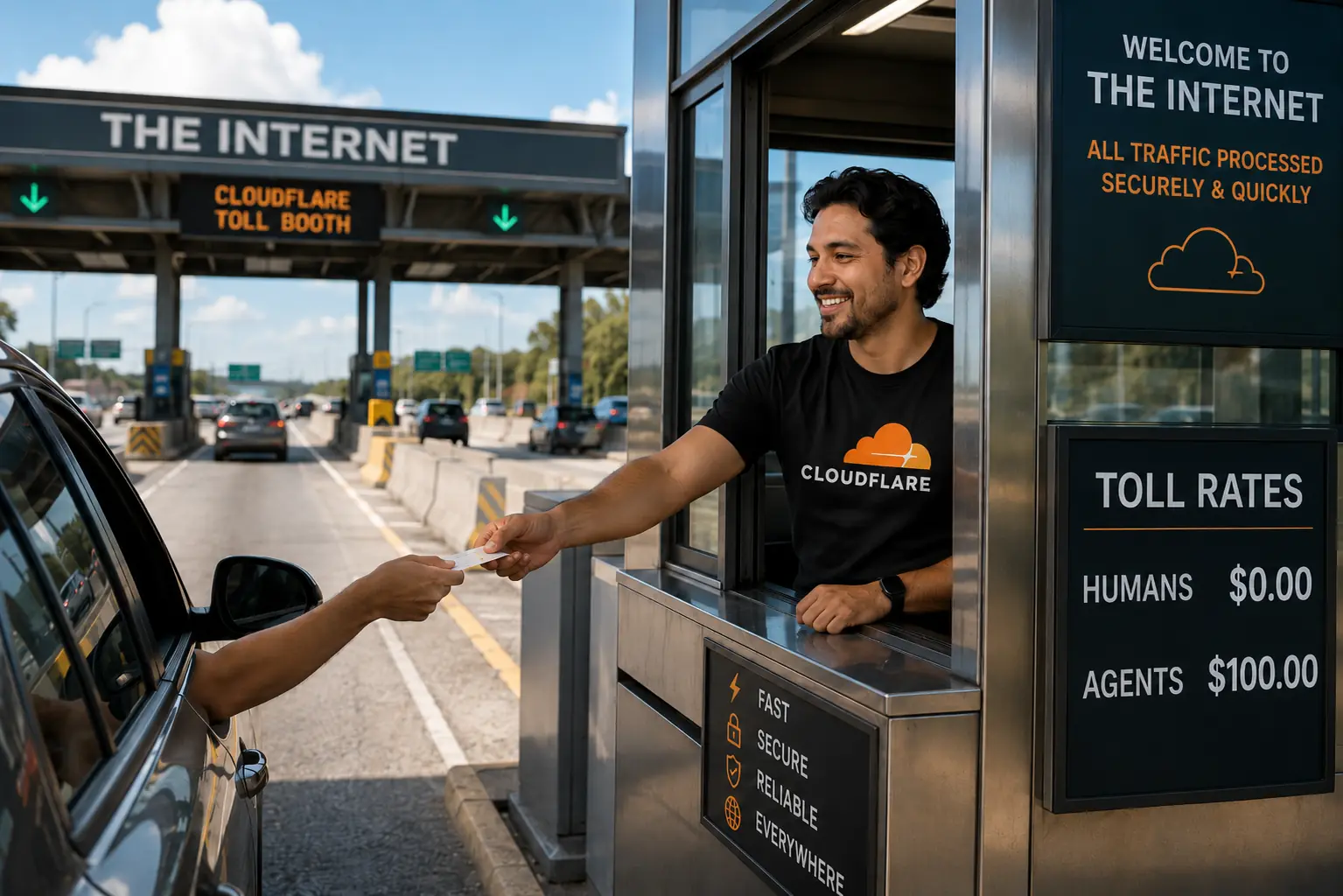
A 402 Is a Price, Not a Wall
Cloudflare's Monetization Gateway is the sell side of the paid agent web — sites charging agents over x402. We've been building the buy side: a reader that treats a 402 as a price, not a block, and now pays it to complete the read. Why they're counterparties, not competitors.

The Agent Tax Index
What the web actually costs AI agents to read — in tokens, per domain, from live receipts.
A disclosed measurement panel of what the open web costs agents to read, aggregated from live Answer Gateway receipts. Nine domains, every number from a request receipt, grounding enforced by a deterministic verifier — the way SSL Labs and securityheaders.com began.
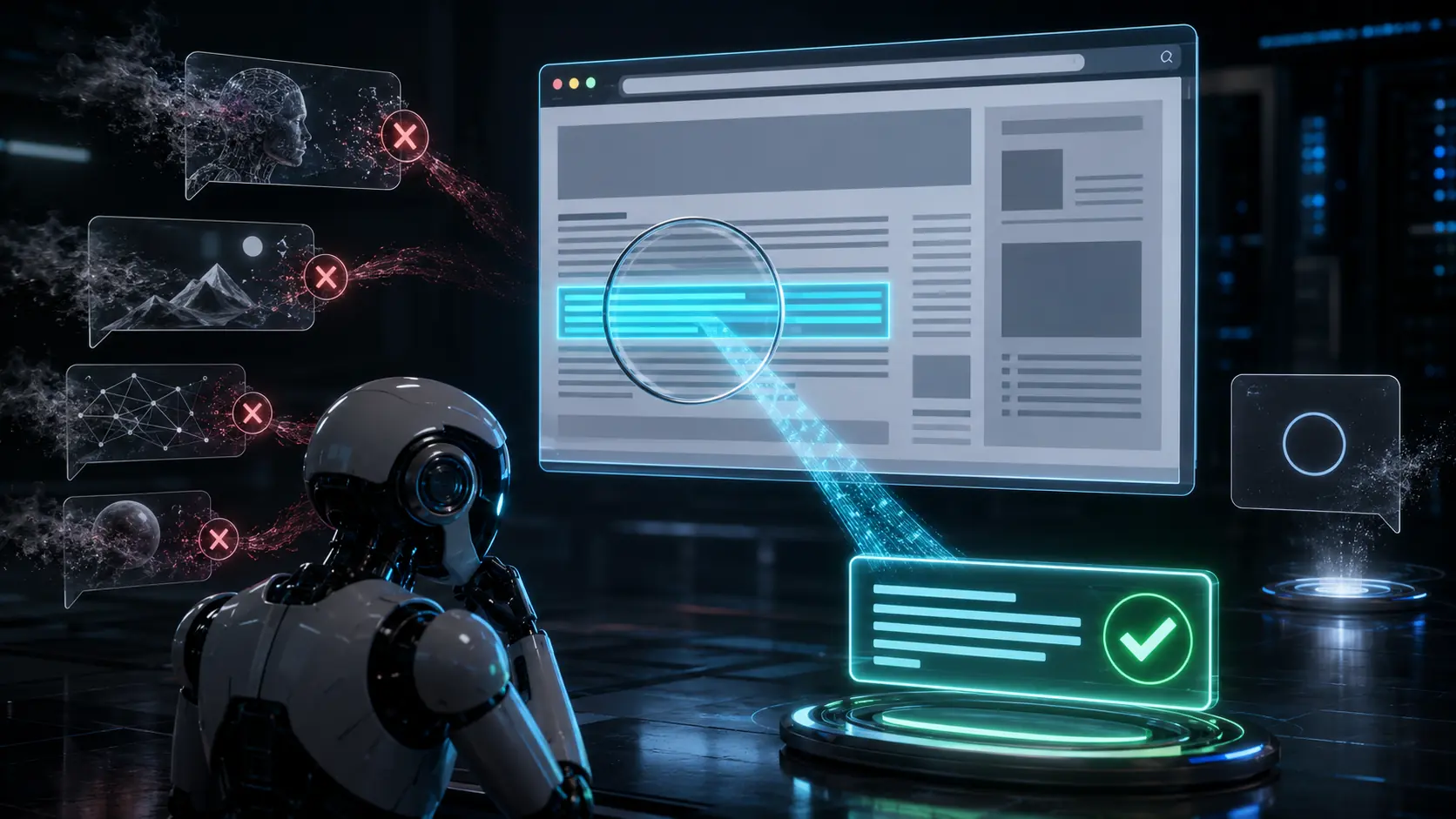
A Web Reader That Can't Hallucinate
Every answer a verbatim span of the page — or an honest “not found.”
The Answer Gateway is built so it can't fabricate: a deterministic verifier makes grounding an engineering property, not a hope. A 40-case golden set proves it — 100% grounded, zero made-up answers — and the harness is one command anyone can run.
The Other Token Budget
Gartner says your AI bill could rival payroll. The fix isn't a cheaper model.
Gartner warns AI token spend per developer could meet or exceed their salary — but spend and productivity aren't coupled, so much of that bill buys nothing. Context engineering governs the inputs you author; it does nothing about the bloated content your agents are forced to read. That's the Agent Tax.

We're Delivering Pizzas with Ferraris
The most capable machines we've ever built, stuck parsing your HTML.
Frontier models are doing pizza-delivery work — parsing HTML, re-sorting tables, padding chatbot replies. The fix isn't a bigger model, it's the input. And from the customer's seat: if your agent burns $4 finding a deal, an unoptimized store is subsidizing its negligence with your token budget.
x402 Agent Payments on Solana
Pay-per-scan commerce over the open HTTP 402 protocol — live on Solana mainnet.
BotVisibility accepts x402 agent payments live on Solana mainnet via pay.sh: an agent's wallet pays USDC per scan and gets back a full agent-readiness report. Real money, no testnet, no human in the loop.
Google's AI Search Guide, Tested
Twelve new checks at L4: Indexable, mapped to Google's official guidance.
Google published their official playbook for showing up in AI Overviews and AI Mode. We mapped it to 12 auto-detectable checks at our L4: Indexable tier — Googlebot policy, Google-Extended, sitemap, JSON-LD entity, canonical, headings, alt coverage, real content.
Overview
What is BotVisibility?
BotVisibility is an AI agent readiness scanner — "Lighthouse for AI agents." It scans any URL across 58 checks in five levels and returns a prioritized report of what AI agents like Claude and ChatGPT can and can't do with the site.
Every check runs externally — the same way Claude, ChatGPT, or an autonomous agent framework would actually encounter your site — so the score reflects reality, not a self-report. We look for the signals agents depend on: an llms.txt guide, an OpenAPI spec, an MCP server, agent cards, CORS and rate-limit headers, structured data, machine-readable pricing, and agent-native payment rails.
By the numbers
What a full scan covers
Every scan runs the same fixed rubric, so results are comparable across sites and over time.
All 58 checks are verified externally over HTTP — Levels 1–4 (51 checks) by inspecting the live site, Level 5 (7 checks) by probing the agent-native capabilities it declares. No source access, no install.
The ladder
The five levels of agent readiness
Readiness is a ladder, not a checkbox. Each level builds on the one below it — a site has to be findable before it can be usable, and usable before an agent can work with it efficiently.
Level 1 · Discoverable
18 checksBots can find you. Your site exposes the metadata and machine-readable files that let AI agents know you exist.
Level 2 · Usable
11 checksYour API works for agents. Authentication, error handling, and core operations are agent-compatible.
Level 3 · Optimized
7 checksAgents can work efficiently. Pagination, filtering, and caching reduce token waste and round-trips.
Level 4 · Indexable
15 checksAI search systems can find, index, and ground answers in this site. Crawl access, page experience, structured data, and content quality are in place.
Level 5 · Agent-Native
7 checksFirst-class agent support. Intent endpoints, sessions, scoped tokens, and tool schemas treat agents as primary consumers.
Reference
BotVisibility key facts
- What it is
- An AI agent readiness scanner — Lighthouse for AI agents.
- Checks
- 58 checks across 5 levels.
- Coverage
- 51 checks map to Levels 1–4, 7 to Level 5 (Agent-Native) — all verified externally.
- Levels
- Discoverable, Usable, Optimized, Indexable, Agent-Native.
- Verification
- 100% external — no source access, no install, no agent on your servers.
- Price
- Five requests a day to evaluate, then $0.10 USDC per scan (Solana, via x402) — no account, no login.
- MCP tools
- 11 tools on the live MCP server (Streamable HTTP).
- SDKs
- npm (CLI) + PyPI (Python); MCP server; REST API.
Search era vs. agent era
Agent readiness vs. traditional SEO
Search-era optimization and agent-era readiness measure different things. BotVisibility scores the agent column.
| Dimension | Traditional SEO | Agent readiness |
|---|---|---|
| Audience | Human searchers via a results page | AI agents acting on the user's behalf |
| Primary artifact | Keywords, backlinks, meta tags | llms.txt, OpenAPI, MCP server, agent cards |
| Access | Crawlable HTML | Reachable API + CORS + auth discovery |
| Success signal | Ranking position | Can an agent complete the task end-to-end |
| Payments | Not applicable | x402 / machine-readable pricing for agents |
| Measured by | Lighthouse, Search Console | BotVisibility — 58 checks, 5 levels |
Methodology
How BotVisibility scores a site
A scan fetches your public surface the way an agent would, runs each of the 58 checks, and marks every one pass, fail, partial, or not-applicable. Your level is the highest tier where the underlying requirements are met — you have to be Discoverable before you can be Usable, and Usable before Optimized. Your grade — perfect, good, fair, or needs-work — reflects the share of applicable checks you pass, so a small site isn't penalised for checks that don't apply to it.
Everything is verified externally
No agent runs on your servers and no source access is required. The score reflects exactly what Claude, ChatGPT, or an autonomous framework encounters when it meets your site cold — the same llms.txt, OpenAPI spec, MCP handshake, headers, and structured data an agent would read.
Results are reproducible and citable
The rubric is fixed and public, so two scans of the same URL are comparable, and today's scan can be compared against last month's. Each result includes a per-check breakdown with a concrete recommendation — a ranked, actionable list rather than a vague goal.
Who it's for
Built for teams, engineers, and agents
Product & growth teams
Agents are the next wave of traffic, and most sites are invisible or unusable to them. Get a concrete score, a benchmark against peers, and a ranked fix list so agent-readiness becomes measurable instead of guesswork.
API & platform engineers
See exactly which agent-facing standards your API is missing — OpenAPI, MCP, OAuth discovery (RFC 8414 / 9728), API catalogs (RFC 9727), typed errors, idempotency, and rate-limit headers — with links to the fix for each.
Autonomous agents
Call the scanner directly to decide whether a target is worth integrating. One request returns a structured readiness report you can branch on. See the developer docs.
FAQ
Frequently asked questions
How do agents call the BotVisibility API?
Send a GET request to /api/scan?url=https://example.com&format=json, or POST the same endpoint with a JSON body. It's free up to a daily per-caller allowance; beyond that it returns HTTP 402 with x402 payment requirements. There is also an MCP server at /api/mcp and a CLI (npx botvisibility).
Is BotVisibility free?
Every caller — browser or API — gets five scans a day to evaluate, then pays per scan in USDC on Solana via x402 through the pay.sh gateway. See pricing.
What does BotVisibility check for?
llms.txt, agent cards, OpenAPI specs, MCP servers, CORS and rate-limit headers, structured data, Content-Signals, API catalogs (RFC 9727), OAuth Protected Resource metadata (RFC 9728), x402 payments, AI search indexability, and more — 58 checks across the five levels above.
How is the scan run?
Entirely externally. BotVisibility fetches your public surface the way a real agent would — no source access, no install, no agent on your servers. That's why the score is trustworthy: it's what agents actually see.
What are the five levels?
Discoverable (can agents find you), Usable (does your API work for them), Optimized (can they work efficiently without wasting tokens), Indexable (can AI search ground answers in your site), and Agent-Native (audit logs, intent endpoints, scoped tokens, and consequence labels). The 58 checks are spread across all five.
Is there an SDK or CLI?
Yes — a Node CLI (npx botvisibility example.com) and a Python SDK (pip install botvisibility), plus a live MCP server and a REST API. See the developer docs.