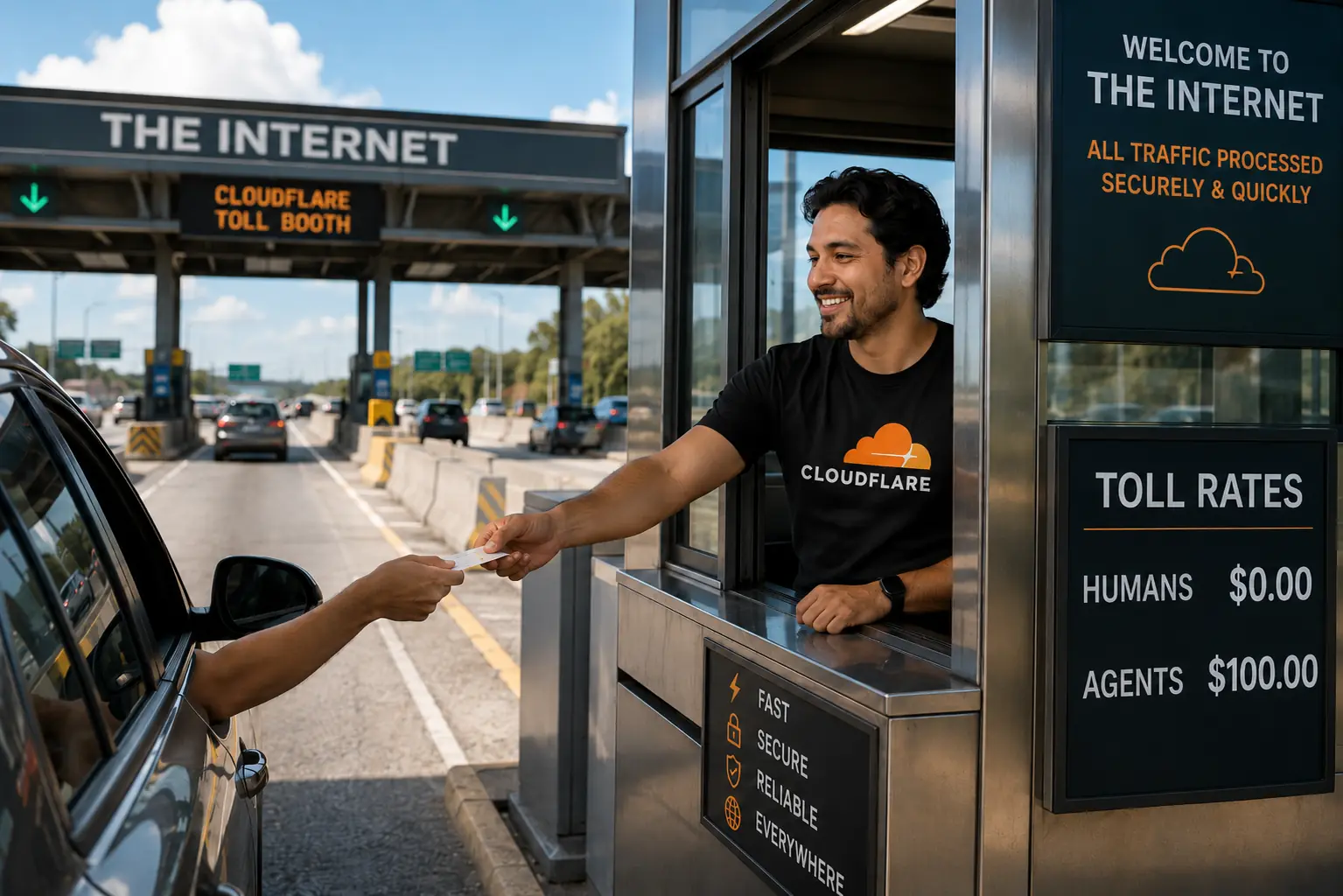
On July 1, 2026, Cloudflare announced the Monetization Gateway: any site behind Cloudflare will be able to charge agents for any resource — a page, a dataset, an API, an MCP tool — settled in stablecoins over x402. It is the institutional arrival of an idea we have been building on, in production, from the other side of the transaction. Cloudflare is building the toll booth. We have been building the driver who reads the sign, knows the price, and decides.
The web is learning to charge per request
For thirty years the web ran on one bargain: content for human attention, monetized by ads, subscriptions, and checkout. Agents break that bargain. An agent doesn't look at an ad or keep a monthly seat; it reads a page once, takes what it needs, and moves on — a hundred to tens of thousands of times per human it sends back. The replacement isn't another subscription. It's usage-based pricing for everything, denominated in the unit agents actually consume: the request, the token, the outcome. x402 is what makes that unit collectible — a price quoted and paid inside an ordinary HTTP request, small enough to be a fraction of a cent, with no account and no prior relationship because the payment itself is the credential. Cloudflare's thesis is correct. We took the same bet, earlier, and from the buy side.
Our receipt was built for a web that didn't exist yet
BotVisibility already runs x402 rails on the sell side: an agent can buy a deep scan for ten cents in USDC over x402, through a published pay.sh provider gateway, with no signup. That was the easy half. The interesting half is the Answer Gateway — a reader that fetches any site for an agent and returns a grounded, excerpt-cited answer at a fraction of the tokens, with a verifier that guarantees it won't fabricate.
When we designed that gateway's receipt, every response already carried two fields we set to zero: fee_usd and source_cost_usd. They did nothing. They were seam discipline — placeholders for a paid web that hadn't been built. Cloudflare just built the thing that populates them. No architecture changed; the field was waiting.
A 402 is a price, not a wall
Most systems that read the web treat an HTTP 402 Payment Required the way they treat a 403 — a closed door, an error, a dead end. It isn't. It's a quote. This week the Answer Gateway gained a distinct terminal state, payment_required, that reads the x402 payload, reports what the page costs to read — the amount, the asset, the network, the address — and, in this version, stops there. It does not pay. It turns every 402 from a wall into a data point.
The distinction matters more than it sounds. A gateway that collapses 402 into “unreachable” throws away the one number the paid web is about to make valuable: the price the site itself posted. As far as we can tell, the Answer Gateway is the first buy-side reader that answers a 402 as a quote rather than an error — ready to meet the Monetization Gateway on the day it emits its first one.
Counterparties, not competitors
It would be easy to read Cloudflare's announcement as competition. It's the opposite. They built the sell side — sites charging agents. We built the buy side — agents reading efficiently and verifiably. These aren't rival products; they're the two ends of the same transaction. Every site that turns on the Monetization Gateway makes our gateway more valuable, because now a wasteful read isn't just a token cost, it's a dollar cost — and avoiding it is worth real money.
Which sharpens the sell. The developer buying the Answer Gateway used to be buying two things: trust, because it won't make things up, and efficiency, because it burns fewer tokens. On a web that charges per read, they're buying a third: cost control. Our two-layer cache means a popular page is paid for once per cache window, not once per question — we amortize the paid web across an agent's requests, and the receipt itemizes the proof: what the page charged, what the answer cost, what the cache saved. “We reduce token waste” is a good pitch. “We amortize the paid web across your requests” is a better one, and it's the same architecture.
Someone has to keep the public record
The Agent Tax Index measures what the web costs agents to read, denominated in wasted tokens, from live request receipts. Cloudflare just handed it a second denomination: dollars per read, set by the site itself. The Index already captures the posted price on every request that returns one, so it can publish, per domain, both the token overhead and the dollar toll. Cloudflare will know what its own customers charge; it has no incentive to publish that comparably, across the web, next to a token-cost benchmark. We do — and we can, because our reads are grounded and receipted. The public record of what the paid web costs agents is a job for a neutral, verifiable reader, not for the toll operator.
The honest limits
We don't pay yet, and that's deliberate. Reporting the price and stopping is zero-risk and already generates the record. When we do wire pass-through payment — the gateway settling a 402 on the agent's behalf, then passing the cost through on the receipt — we'll keep the float small and the accounting strictly per-receipt, because fronting money between an agent's payment to us and ours to the source is a liability to manage, not a feature to rush. The seam is in place. The discipline comes first.
Where this goes
The end state is an agent-first web where the request is the transaction — where the smallest new API reaches the same buyers as the largest company, and the independent creator is paid by the models that use their work. Cloudflare is building the settlement rails at the edge, close to the buyer. We're building the reader that meets them: proof of what was read, a grounded answer, and an itemized receipt of what it cost. The toll booth and the driver, arriving at the same intersection from opposite directions — and the sooner both exist, the sooner the web's next business model actually works.